
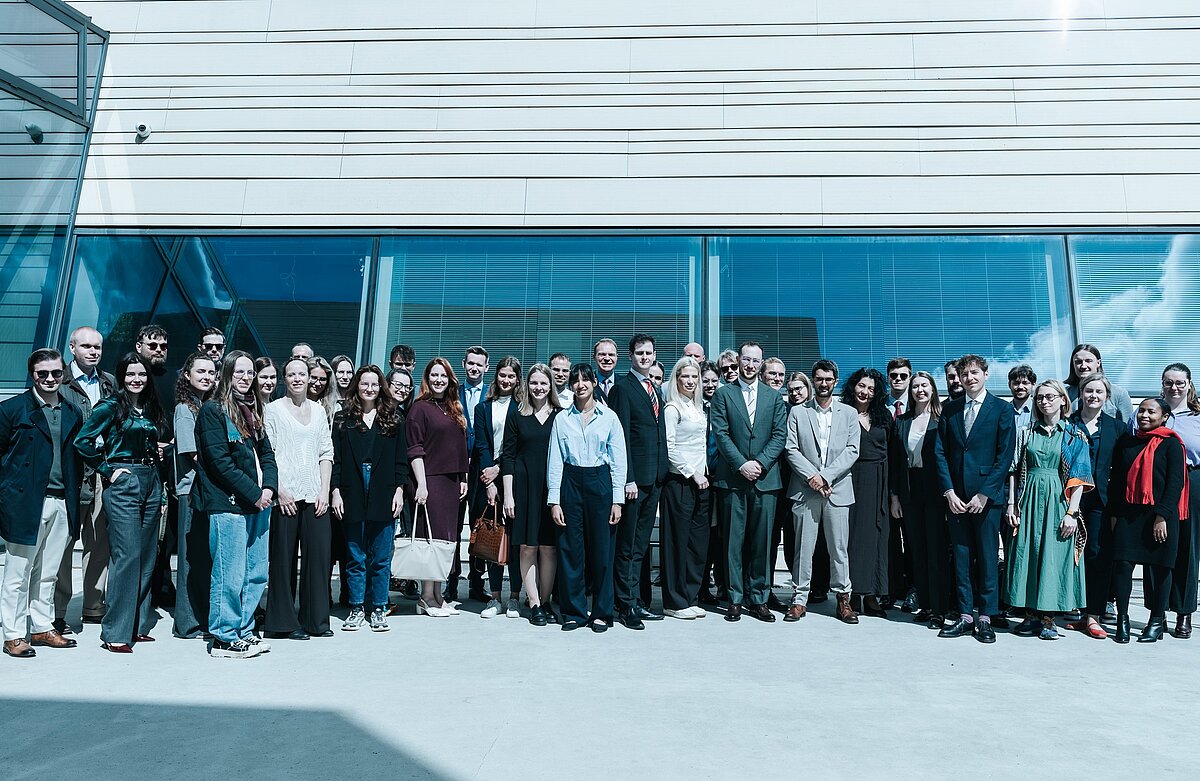



The UL Faculty of Law was represented by doctoral students Mārcis Vanders, Sintija Zalāne, Kitija Koroševska, and Kristīne Nagle, who presented their research on issues related to the digital economy, copyright, the digitalisation of judicial proceedings, and the exchange of personal data.
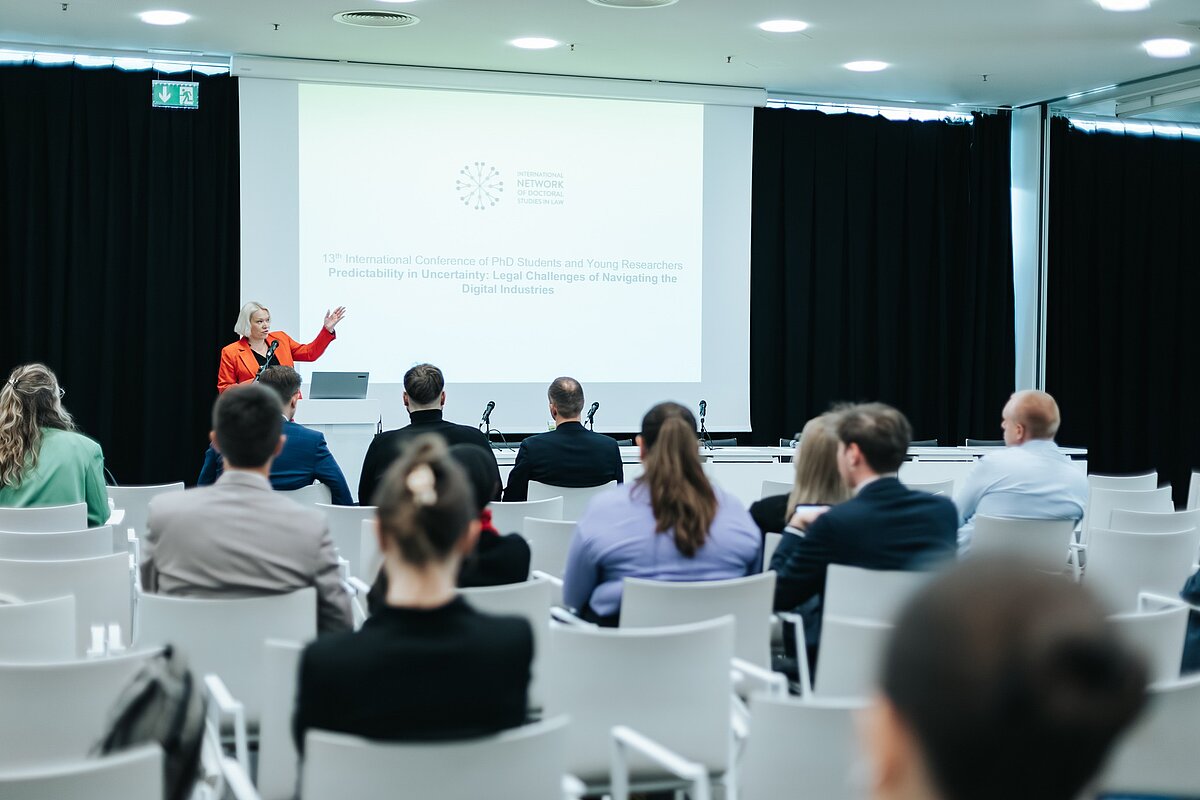
The conference brought together doctoral students and early-career researchers from various European universities, including Trier University, Goethe University Frankfurt, Paris Nanterre University, the University of Warsaw, the University of Antwerp, Charles University in Prague, and other higher education institutions. Research was presented in several thematic sessions focusing on artificial intelligence, digital law, data protection, platform regulation, crypto-assets, competition law, intellectual property, procedural law, and other current legal challenges arising from the digital environment.
Mārcis Vanders presented his research entitled “Crypto-Assets and Their Place in Private Law”. He highlighted the rapidly growing importance of the digital economy worldwide, while noting that crypto-assets are still often narrowly associated only with Bitcoin. He pointed out that the European Union’s Markets in Crypto-Assets Regulation (MiCA) contributes to structuring the crypto-assets market, but at the same time creates challenges for private law, as the concept of crypto-assets used in the regulation is highly specific and is not always easily integrated into civil law systems.
Sintija Zalāne presented the paper “Authors’ Moral Rights after Death as an Instrument of Cultural Governance in the Context of (De)Globalisation in Europe: Power, Legitimacy and the Public Interest”. The research concluded that the protection of authors’ moral rights after death is not merely a matter of private law or a technical copyright issue, but also functions as a mechanism of cultural governance. These questions are becoming increasingly complex, particularly in the digital environment, where authors’ works are used across borders on digital platforms, in remixes, digital archives, and through new technologies.
Kitija Koroševska presented in the session “Procedural Law, Courts, Enforcement & Criminal Justice” with the paper “When Deception Enters the Courtroom: Legal Mechanisms for Safeguarding Testimonial Integrity in the Digital Age”. The research examined how remote court hearings and testimony provided via videoconference affect judicial proceedings, including perceptions of the seriousness of the process and the credibility of testimony. Conference discussions paid particular attention to the legal consequences of knowingly providing false testimony, as well as to different national approaches to the right of defence.
Kristīne Nagle, in turn, presented the research “Exchange of Personal Data between Public Administration Authorities for Innovation and Research”. Participation in the conference provided an opportunity to discuss current trends in legal research with early-career researchers from other countries and to compare different national approaches to similar legal challenges. Particularly valuable was the opportunity to establish new international academic contacts that may foster future professional and research cooperation.
Participation in international conferences is an important part of the academic development of doctoral students. It provides an opportunity to present research findings in an international environment, receive feedback from foreign colleagues, further develop argumentation skills, and strengthen the involvement of the UL Faculty of Law in the European legal research community.
The UL Faculty of Law is proud of the active involvement of its doctoral students in research and the international academic community and wishes them continued success in their future research.
 participated in the 13th International Conference for Doctoral Students and Early-Career Researchers, “Predictability in Uncertainty: Legal Challenges of Navigating the Digital Industries”, held on 14–15 May 2026 at the Faculty of Law of Vilnius University in Vilnius, Lithuania.)